Kill aperture overthinking with three anchor points: f/2 for a single person, f/5.6 for two or more bodies in one plane, f/8 when the environment is part of the story. Pick the anchor, confirm your focus plane, shoot. Adjust only when the frame tells you to.
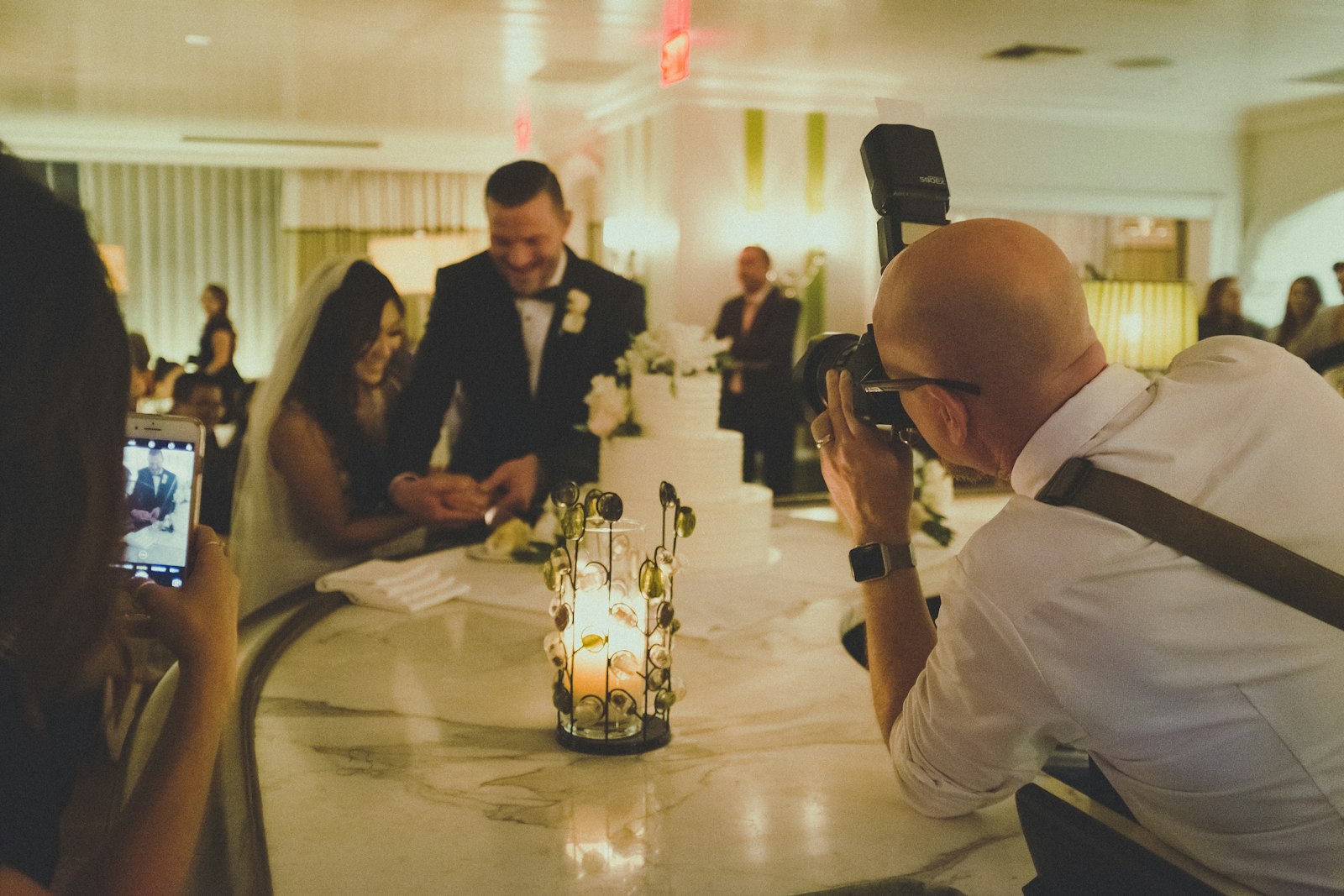
Reception hall, somewhere around 9:40pm. The band is between songs, the light is that ugly amber-plus-LED-uplighter soup every DJ loves, and the groom’s grandmother has just stood up to hug her great-grandchildren. Three bodies. Two rows of depth. Maybe four seconds of moment left.
And I’m standing there spinning my front dial like a man cracking a safe.
f/1.8? Too thin, I’ll lose one of the kids. f/4? Now I’m at ISO 12800. f/2.8 is the coward’s compromise, which is exactly why my thumb keeps landing there. By the time I commit, grandma has sat back down and I have one frame with a sharp ear and two soft faces.
That moment is aperture overthinking, and it has cost me more good photographs than bad autofocus ever has. Not because I don’t know what aperture does. Because I know too much about what it does, and knowing too much is paralysis with a degree.
Why Does Aperture Overthinking Happen to Photographers Who Already Know Better?
Here’s the uncomfortable part. Aperture overthinking isn’t a beginner problem. Beginners shoot wide open, love the blur, go home happy. Aperture overthinking arrives the moment you learn enough to see the tradeoffs, and then it never leaves.
You learn about diffraction. You learn your lens isn’t sharpest wide open. You learn depth of field math. You learn about focus shift, field curvature, and the fact that f/1.4 on a 85mm at six feet gives you roughly the depth of a credit card. Every one of those facts is true. Every one of them is also a voice in your head during a four-second moment.
Fstoppers published a piece this month arguing for three anchor points to kill aperture overthinking, and the core idea is one I’d argue for harder than they do: you don’t need a better understanding of aperture. You need fewer options.
Let’s be blunt about the real cost. Aperture overthinking doesn’t produce worse exposures. It produces missed frames. Those are not the same failure, and only one of them is unfixable in post.
The Three-Anchor Framework That Ends Aperture Overthinking

The framework is stupid-simple on purpose. Three numbers. You count bodies, you check your background’s job, you pick. Nothing else enters the decision until after the shutter fires.
- f/2 — one subject, one plane. Single person, headshot through waist-up, background is noise you want gone. Not f/1.2, not f/1.4. f/2 gives you a subject-shaped falloff with enough margin that a head turn doesn’t cost you an eye.
- f/5.6 — two or more bodies, or any subject with real depth. Couples, family groups, a person in profile turned toward camera, hands reaching forward. The moment a second body enters frame, the decision is already made.
- f/8 — the environment is part of the story. Wide establishing frames, venue shots, a subject deliberately small in a place that matters. Also your default for anything with signage, architecture, or a horizon you want legible.
That’s it. Three numbers cover something like eighty percent of what I shoot in a working day, and the remaining twenty percent announces itself clearly enough that I’m not agonizing.
The power here isn’t that these are the optimal apertures. They’re not. The power is that the decision takes under a second, which means the thinking you were burning on aperture overthinking gets spent on where to stand and when to press.
Step One: Count Bodies Before You Touch the Dial
Before anything else, count. Not consciously, not out loud, just register it. One person or more than one?
This single question resolves most aperture overthinking on the spot, because the failure mode of a group shot is never “not enough blur.” It’s “aunt Denise is soft.” Nobody has ever complained that a family photo had too much of the family in focus.
I learned this the expensive way. I shot a five-person family group on a covered porch at f/2.2 because the light was dying and I told myself I’d nail the focus plane. I got the mother tack sharp. I also got a teenage son, standing maybe fourteen inches behind her, rendered like a watercolor. That frame was the one they wanted printed.
So the rule got hard-coded: second body in frame means f/5.6, and I don’t negotiate with myself about it. Negotiating is aperture overthinking wearing a professional hat.
Step Two: Ask What Job the Background Has
Backgrounds do one of two things. They either carry information or they carry noise. Deciding which one takes about as long as it takes to read this sentence.
Noise background: exit signs, a rolling cart, a stranger in a neon jacket, a parking lot. Blur it. That’s your f/2 case if you’re on one subject, or your f/5.6 case if you’re on more than one and you’ll accept softer noise instead of absent noise.
Information background: the ceremony arch, the mountain range, the shop the subject built with her hands, the client’s product line on the shelf behind her. Now you’re at f/8, and the fact that you’re at f/8 with a 50mm f/1.2 on the body is not a waste. It’s a decision.
Here’s where aperture overthinking gets sneaky. Owning a fast lens creates an obligation to use it wide open, and that obligation is entirely fictional. You bought the f/1.4 for low light and for the option. An option you never decline isn’t an option, it’s a habit.
Step Three: Confirm the Focus Plane, Not the Aperture
Once you’ve picked the anchor, the remaining question is never “is this the right f-stop.” It’s “am I focused on the right surface.”
At f/2 on a single subject, the answer is the near eye, always. Not the nose, not the cheek. At f/5.6 on a group, the answer is the second row back if there are three rows, or the front row if there are two. At f/8 with an environment, the answer is your subject, and the background comes along for the ride.
Making focus the active decision instead of aperture reframes the whole problem. Aperture becomes something you set once per scenario; focus becomes the thing you’re actually working. That reallocation is what makes the framework beat aperture overthinking in practice rather than just in theory.
And yes, I still blow focus. I shot an entire first-look sequence last spring with back-button focus mapped to a button I’d reassigned two weeks earlier and forgotten about. Twenty frames on the fence behind them. Framework doesn’t save you from being an idiot. It just narrows the ways you can be one.
Step Four: Set an Exposure Escape Hatch
The honest objection to the three-anchor approach is light. f/5.6 in a dark reception means ISO numbers that used to be a punchline.
Take them. Modern full-frame files at ISO 12800 clean up into something printable, and a noisy sharp frame beats a clean soft one every single time. The version of aperture overthinking that masquerades as noise discipline has cost working photographers more keepers than any sensor ever did.
If you genuinely can’t get there, the escape hatch is ordered and you follow the order: raise ISO first, drop shutter to your handholding floor second, and only then break the anchor. Breaking the anchor is last, not first.
Set your ISO ceiling once, at the start of the job, and stop revisiting it. A pre-committed ceiling removes one more live variable, and every variable you remove in advance is one less doorway for aperture overthinking to walk through mid-moment.
Step Five: Break the Anchor Deliberately, Not Anxiously

Anchors are defaults, not commandments. There are real reasons to leave them, and they share one trait: you can say the reason out loud in a short sentence.
“I want the string lights to read as distinct orbs” is a reason to go to f/1.8. “I’m shooting a flat-lay of the invitation suite and need corner-to-corner detail” is a reason to go to f/11. “I want the chapel windows legible behind them” is a reason to go to f/8 on a single subject.
“I dunno, f/2.8 feels safe” is not a reason. That’s aperture overthinking with the volume turned down, and it’s the most common version of it on set.
The test I use: if I can’t articulate the break in one clause before the shutter fires, I stay on the anchor. Deliberate breaks make better photographs. Anxious breaks make inconsistent galleries, and inconsistency is what clients actually notice when they scroll.
How the Framework Holds Up Across Real Jobs
A senior portrait session in late September, which is exactly where a lot of us are this week. Single subject, field of dead goldenrod, sun behind. f/2 for the tight frames, f/8 for the three or four wides that show the field. Two numbers, ninety minutes, zero aperture overthinking.
A commercial headshot day, fourteen people through a conference room. f/5.6 for every seated subject because the client wants the logo wall readable. One number. Aperture doesn’t move for four hours.
A ceremony. f/5.6 down the aisle because the couple and the officiant are three planes deep. f/8 for the wide from the balcony. f/2 for the single reaction shots of the mother in the front row. The anchors swap as the subject count changes, and that swap is a reflex rather than a deliberation.
The gear barely matters here, which is the other reason aperture overthinking is so wasteful. A Canon EOS R6 at f/5.6 and a Sony A7 IV at f/5.6 produce the same depth of field on the same focal length. You are not solving a hardware problem.
What Aperture Overthinking Actually Costs You Over a Year
Not sharpness. Not bokeh quality. Not any of the things forum arguments are about.
It costs moments. It costs the frame between the two frames you got, the one where the expression had actually landed. It costs decisiveness, which reads in a gallery as a point of view, and it costs the mental bandwidth you needed for composition and timing and reading a room.
It also costs consistency across a body of work. When your aperture is a fresh anxiety in every scenario, your look drifts. Clients can’t name that, but they feel it, and they hire the photographer whose galleries hang together.
Three numbers. That’s the whole intervention. I resisted it for years because it felt reductive, and reductive is exactly what a four-second moment requires.
What to Take From This
- Count bodies first: one subject in one plane is f/2, two or more is f/5.6. No negotiation.
- Judge the background’s job: noise gets blurred, information gets f/8.
- Make focus the live decision: near eye at f/2, second row at f/5.6, subject at f/8.
- Pre-commit your ISO ceiling: raise ISO before you break the anchor, every time.
- Break anchors in one clause or not at all: if you can’t say why, stay put.
- Owning a fast lens is not an obligation: wide open is a choice, not a default.
None of this makes you a better technician. You already are one, and that’s precisely the problem, because aperture overthinking is a technician’s disease. What three anchor points buy you is the one thing technical knowledge can’t: speed of decision under pressure. Set the anchor, confirm the focus plane, press the button, and spend the recovered attention on where you stand and when you shoot. Do that for a season and you’ll find aperture overthinking stops being a thing you fight and starts being a thing you used to do.
FAQ
Does the three-anchor framework work on crop sensors?
Yes, with one adjustment. APS-C at f/2 gives roughly the depth of field of full frame at f/3, so the anchors run slightly safer. Micro Four Thirds shooters can often hold f/4 where full frame needs f/5.6.
What if I only own a variable-aperture zoom?
The framework gets easier. An f/4-6.3 kit zoom lives almost entirely inside the f/5.6 and f/8 anchors already, which removes the f/2 decision completely and eliminates most aperture overthinking before it starts.
Isn’t f/5.6 wasteful on a lens I paid extra for?
No. Fast glass buys you low-light capability and the option of shallow depth. Declining that option on a group shot is using the lens correctly, not wasting it. The purchase bought flexibility, not an obligation.
How do I stop aperture overthinking when a client is watching me hesitate?
Set your anchor before they arrive. Walk in with f/5.6 already dialed for the first scenario, so your visible first action is framing rather than fiddling with dials. Confidence is partly choreography.
Should I ever shoot wider than f/2 on a single subject?
Sometimes. Deliberate specular-highlight work, extreme low light with no flash option, or a stylistic look you’ve committed to for a whole gallery. State the reason in one clause first, then open up.
Photo: 27 1