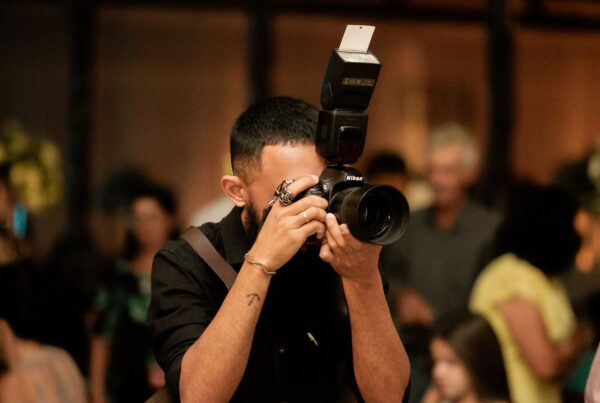

The bride’s grandmother was mid-speech when my main camera died. Not a low battery warning. Not a card error. Dead. The kind of silence that makes your stomach drop through the floor of the reception hall. I watched her wipe tears, sharing a story about meeting her late husband — the moment every wedding photographer waits for — while I fumbled for my backup body with hands that suddenly felt like oven mitts. This is the reality of wedding photography problems: they don’t schedule themselves around the timeline.
Twenty seconds. That’s how long it took to switch cameras and catch the end of that speech. But those twenty seconds taught me more about this job than any workshop ever could. Because here’s what they don’t tell you: the difference between a wedding photographer and someone who panics with a camera isn’t skill. It’s systems.
When Cards Corrupt and Batteries Die
Let me paint you a picture. It’s 11:47 PM at a vineyard wedding in Napa. The couple just announced a surprise fireworks show — the kind of moment that ends up on gallery walls. You raise your camera, and… nothing. Dead battery. No warning. Your spare? In the car, because you “just grabbed it for a second” during cocktail hour and never put it back.
Redundancy isn’t paranoia. It’s professionalism. Every wedding photography problem I’ve survived came down to one rule: assume everything will fail, then prepare for when it does.
My current setup? Two bodies, minimum six batteries, eight memory cards. Sounds excessive until you’re shooting your 200th wedding and realize you’ve used every single backup at least once. That vineyard wedding? Shot the fireworks on my second shooter’s camera while she covered the crowd reactions. We made it work, but I’ve never left a battery in the car since.
The non-negotiables: Primary and backup bodies on different straps. Batteries in rotation — never let one die completely. Cards switched every major moment, not when they’re full. Think of it like this: if your gear failed right now, how many seconds until you’re shooting again? If it’s more than ten, your system has holes.
Recovering From the Unrecoverable
Alright, let’s talk about the wedding photography problems that wake you up at 3 AM in a cold sweat. The missed moments. The ones you can’t reshoot.
Last September, I missed a first look. Not “missed the perfect angle” — missed it entirely. GPS sent me to the wrong entrance of a sprawling estate. By the time I found them, the groom was already wiping his eyes, and the videographer was packing up. Game over, right?
Wrong. Here’s what twenty years of near-disasters teaches you: every moment has an echo. You can’t recreate the first look, but you can find the second one. The moment during portraits when he fixes her necklace and they lock eyes. The pause before entering the reception when she squeezes his hand. These aren’t consolation prizes — they’re often more genuine than the scheduled moments.
I pulled that couple aside during golden hour. Told them straight: “I screwed up. But give me five minutes, just the two of you, no posing.” What followed was better than any first look I’ve shot. Real tears. Real connection. No performance for the cameras.
The lesson? Own your mistakes immediately. Don’t make excuses. Then find the moment that’s still there, waiting. Because wedding photography problems aren’t really about missing shots — they’re about losing trust. Keep the trust, and you can recover almost anything.
When Weather and Venues Revolt

Picture this: Outdoor ceremony. Forecast said partly cloudy. What you get instead is Noah’s Ark levels of rain starting exactly as the processional music begins. The coordinator looks at you like you control the weather. The bride’s makeup is running. The groomsmen are using programs as tiny, useless umbrellas.
Weather might be the most common of all wedding photography problems, but it’s also the most opportunity-rich. That disaster? Became the couple’s favorite story. We moved everything under a tiny gazebo, guests huddled together like penguins, and I shot the whole ceremony at 1600 ISO through sheets of rain. The images looked like a movie — dramatic, intimate, unforgettable.
But here’s the real talk: you need a rain plan before you need a rain plan. Scout covered areas during your venue walkthrough. Keep lens cloths in every pocket. Know your camera’s ISO limits before you’re testing them live. Most importantly? Stay calm. If you’re stressed, everyone’s stressed. If you’re excited about the “romantic rain shots,” suddenly it’s an adventure.
Venue surprises work the same way. That gorgeous window light you scouted? Covered with blackout shades for the AV setup. The getting-ready suite they promised? A storage closet with one overhead fluorescent. These aren’t photography problems — they’re photography normal. Your job is to make anywhere look like somewhere.
Client Communication Under Fire
The timeline says speeches at 8:00. It’s 8:47, nothing’s happened, and the coordinator is MIA. The couple keeps asking if they should just start. The DJ is playing the same Ed Sheeran song for the fourth time. This is when wedding photography problems become people problems.
Here’s what I’ve learned: you’re not just the photographer. You’re the calm in the storm. The couple hired you partly because you’ve done this before and they haven’t. When things go sideways, they’re looking at you.
My approach? Truth, but filtered. “The sunset light is incredible right now — want to sneak out for five minutes while they sort the mic?” That’s better than “Your coordinator vanished and nobody knows what’s happening.” You’re not lying. You’re prioritizing.
I once shot a wedding where the officiant didn’t show. Just… didn’t come. Bride in tears, groom pacing, guests checking watches. I pulled them aside: “Your friend Mark. The one who gave that toast at your engagement party? He’d be perfect.” Turned out Mark was ordained online years ago as a joke. Saved the day. Sometimes solving wedding photography problems means solving wedding problems, period.
But here’s the critical part: know your boundaries. You’re not the coordinator, planner, or therapist. You’re the professional who helps them remember why they’re there. Keep that focus, and you’ll navigate any crisis.
Building a Bulletproof Backup Workflow

Let’s get into the unsexy stuff that actually saves careers. Your backup workflow. Because the worst wedding photography problems happen after the wedding — when you realize that corrupted card was your only copy of the ceremony.
My system evolved from pain. Lost an entire reception to a failed hard drive in 2018. Spent three weeks and two grand trying to recover it. Got most of it back, but those three weeks? Pure hell. Now I run triple redundancy minimum. Cards backed up to laptop during dinner. Laptop backed to portable SSD before leaving venue. Everything to cloud storage that night.
Overkill? A photographer friend thought so. Until her laptop was stolen from her car with two weddings on it. No backups. Career-ending stuff. She shoots corporate events now.
Here’s the workflow that’s saved me multiple times: Dual card slots, writing to both. Import to laptop with Lightroom creating a second copy. External drive backup running simultaneously. Cloud backup overnight. By morning, every image exists in four places. Because wedding photography problems don’t care about your schedule. They strike when you’re exhausted, rushed, or complacent.
The real secret? Make it automatic. The more you have to remember, the more you’ll forget. Set up your import settings once. Use software that backs up automatically. Treat your workflow like your cameras — test it regularly, maintain it religiously.
The Mindset That Beats the Panic
Here’s the truth about wedding photography problems: they’re not problems. They’re the job. Every wedding will have something. Dead battery, missed moment, biblical rain, drunk groomsman who won’t stop photobombing — something will test you. The photographers who last aren’t the ones who avoid disasters. They’re the ones who surf them.
I learned this the hard way. My first year, every crisis felt personal. Missed shot? I’d failed. Technical issue? I wasn’t prepared. Client stressed? I wasn’t good enough. That mindset will kill you faster than any dead battery.
The shift came when I stopped seeing problems as failures and started seeing them as material. That grandmother’s speech I almost missed? It’s now the story I tell nervous couples about why I always have a backup ready. The rain-soaked ceremony? Featured in my portfolio as “romantic documentary style.” Even that missed first look became a testimonial about problem-solving and authentic moments.
This isn’t about spinning negatives into positives. It’s about understanding that perfection isn’t the job. Presence is the job. Being ready is the job. Staying calm when everyone else isn’t? That’s the job.
Look, I could tell you that after enough weddings, the problems stop. That would be a lie. What changes is you. Your systems get stronger. Your recovery time gets faster. Your panic threshold gets higher. But most importantly, you learn that every wedding photography problem has a solution — and usually, that solution is you staying cool while finding it.
The next time your camera dies during the father-daughter dance, or the venue coordinator moves your timeline without telling you, or the heavens open up during golden hour portraits — remember this: you’re not the first photographer to face this moment. You won’t be the last. But how you handle it? That’s what separates the wedding photographers from the people who used to shoot weddings.
Because at the end of the night, the couple won’t remember the technical specs of your backup system. They’ll remember who kept smiling when everything went sideways. Be that photographer.
FAQ
What are the most common wedding photography problems?
Equipment failure (dead batteries, corrupted cards), timeline delays, weather challenges, and missing key moments top the list. But the most common issue? Not having systems in place for when these inevitable problems hit. Every wedding has something go wrong — the photographers who thrive are those who expect it and prepare accordingly.
How do you handle upset clients when something goes wrong?
Immediate honesty and solutions. If you miss something, tell them right away and present alternatives. “I missed the bouquet toss because of X, but I’d love to get some portraits of you with your bridesmaids after.” Most clients appreciate transparency and problem-solving over excuses. Own it, fix it, and often they’ll respect you more for how you handled it.
What backup equipment is absolutely essential for weddings?
Minimum: two camera bodies, 6+ batteries, 8+ memory cards, backup lenses covering your essential focal lengths. But beyond gear, you need backup workflows — dual card slots writing simultaneously, import procedures that create multiple copies, and a same-day backup routine. The gear that fails most often isn’t your camera — it’s your system for protecting what you’ve shot.
Photo: 🇻🇳🇻🇳Nguyễn Tiến Thịnh 🇻🇳🇻🇳