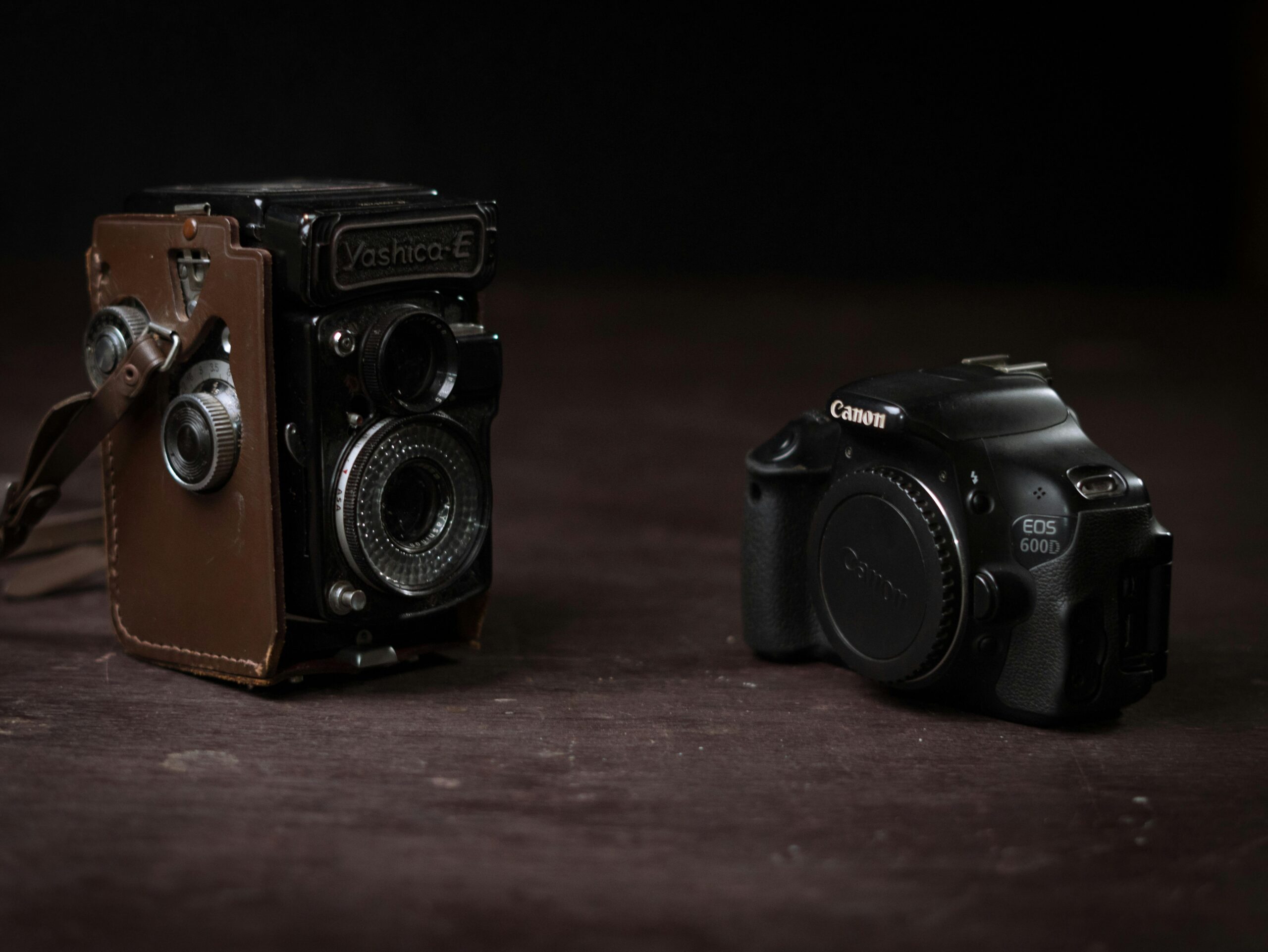
The darkroom at Rayko Photo Center in San Francisco smelled like chemistry and nostalgia — stop bath sharp in your nostrils, fixer sweet underneath. February 2016. I was there for a workshop, watching silver halides do their ancient dance under red light. By December, Rayko was gone. Another film lab casualty. Digital had won, we all said. The war was over. Except here’s the thing about film vs digital photography 2026 — turns out nobody told film it was supposed to stay dead.
I’m writing this on a Tuesday morning, coffee getting cold, with a roll of Portra 400 sitting next to my keyboard. Shot it last weekend. My Canon R5 is in the bag beside me, 45 megapixels of pure digital precision. And honestly? I can’t tell you which one I love more anymore. That’s what makes the film vs digital photography 2026 conversation so strange — it’s not a war anymore. It’s… something else entirely.
The Resurrection Nobody Saw Coming
Here’s what kills me: Kodak almost died. Kodak. The company that basically invented consumer photography filed for bankruptcy in 2012. Digital was supposed to be the asteroid, film the dinosaur. End of story. Except somewhere around 2020, something shifted. Film sales started climbing. Not just climbing — exploding.
The numbers are wild. Kodak can’t make film fast enough. Fujifilm discontinued most of their film stocks, then watched helplessly as remaining prices tripled on the secondary market. A basic film camera that sold for $50 in 2015? Try $500 now. My local lab went from processing 20 rolls a week to 200. They hired three new techs. In 2024.
But here’s the kicker — it’s not nostalgic boomers driving this. Walk into any film lab and count the gray hairs. You’ll run out of fingers before you find them. It’s kids. Gen Z. The TikTok generation chose chemistry over pixels, and nobody can quite explain why. Actually, that’s not true. They explain it constantly. We just don’t want to hear what they’re saying.
Why Gen Z Chose Film (And What It Says About Everything)
“It’s tactile,” a 19-year-old told me at a photo walk last month. She was shooting a Contax T2 that cost more than my car payment. “Digital feels like typing. Film feels like writing.”
Alright. Stop. Let that sink in for a second.
She’s not wrong. There’s something about loading film, advancing the lever, waiting for scans. It’s slow. Deliberate. The opposite of everything their generation was raised on. And maybe that’s exactly the point. When your entire life is algorithmic — when every photo you take can be edited, filtered, posted, deleted, reposted — maybe the appeal of film isn’t quality. It’s commitment.
You get 36 shots. No chimping. No deleting. Every frame costs money. That changes how you see. It changes how you shoot. Hell, it changes who you are as a photographer. The film vs digital photography 2026 debate isn’t technical anymore. It’s philosophical.
One more thing about Gen Z and film — they’re not purists. They shoot film, scan it, edit in Lightroom, post on Instagram. They’re using 1950s technology to feed 2026 algorithms. The irony should break something, but it doesn’t. Because they’re not trying to recreate the past. They’re trying to slow down the present.
Digital Photography’s Midlife Crisis
Meanwhile, digital photography is having what I can only describe as an existential moment. The specs race is basically over. What’s left to improve? More megapixels? We crossed into “more than anyone needs” territory five years ago. Better autofocus? My camera tracks eyeballs at 30fps. In the dark. While I’m running.
Here’s a confession: I haven’t been excited about a new camera announcement in three years. Neither have you. Don’t lie.
The innovation has moved to computational photography — phones doing HDR magic, AI removing people from backgrounds, everyone a photographer, nobody a photographer. The camera companies are scrambling. They’re adding features nobody asked for. 8K video in a photography body. AI scene detection. Wifi, Bluetooth, GPS, kitchen sink. But sales keep falling.
You know what camera had its best sales year ever in 2025? The Fujifilm X100VI. A fixed-lens camera with dial controls and film simulations. Not because it’s technically superior. Because it feels like something. Because it makes photography feel like photography again. The film vs digital photography 2026 conversation has to acknowledge this: digital won every technical battle and somehow lost the emotional war.
The Rise of the Hybrid Shooter
But here’s where the film vs digital photography 2026 story gets interesting. Most serious photographers I know? They shoot both. Film for personal work, digital for clients. Digital for wildlife, film for portraits. They’re not choosing sides. They’re choosing tools.
I met a wedding photographer last summer — been shooting 20 years, fully digital since 2008. Know what she brought to her daughter’s graduation? A Pentax K1000 and three rolls of Tri-X. “Different headspace,” she said. “When I shoot digital, I’m working. When I shoot film, I’m… present.”
That word keeps coming up. Present.
There’s this moment when you’re shooting film. You’ve metered the light, set your exposure, composed the frame. Your finger hovers over the shutter. Is this worth one of my 36 frames? That pause — that fraction of a second — that’s what we lost with digital. That’s what people are buying back at $15 per roll.
The hybrid shooters get it. They’re not treating film vs digital photography 2026 as a binary choice. They’re building a toolkit. Digital for precision, film for poetry. Digital for deadlines, film for meditation. Both for different facets of the same obsession.
What This Debate Is Really About
Let’s not kid ourselves. The film vs digital photography 2026 debate was never really about image quality. Film lost that battle. It’s grainy. It’s inconsistent. It’s expensive. It’s inconvenient. Digital is technically superior in every measurable way.
So why are we still talking about this?
Because photography isn’t about technical perfection. Never was. It’s about seeing. It’s about feeling. It’s about translating the mess in your head into rectangles other people might understand. And somewhere along the line, we confused better tools with better vision.
The film resurgence is a rebellion against that confusion. It’s photographers saying: slow down. Think more. Shoot less. Feel something. It’s not luddism. It’s humanism. In an age of infinite images, the scarcity of film becomes its own statement.
When someone shoots film in 2026, they’re not just choosing a medium. They’re choosing a philosophy. They’re saying: not everything needs to be optimal. Not everything needs to be shared. Not everything needs to be immediate. Some things can just… be.
The Rayko Photo Center darkroom is gone now. Condos, probably. But new darkrooms are opening — in Brooklyn, in Austin, in places where rent makes no sense for chemical baths and enlargers. Kids who never knew the original darkroom era are building new ones. They’re learning what I learned in that February workshop: there’s magic in the waiting.
Film didn’t beat digital. Digital didn’t kill film. In the film vs digital photography 2026 landscape, they’ve become dance partners — each making the other more intentional. Digital taught us what’s possible. Film reminds us what’s meaningful. Maybe that’s how it was always supposed to end.
So which side are you on? Or are you, like me, starting to realize that was never the right question?
FAQ
Is film photography actually growing in 2026, or is it just hype?
The growth is real and measurable. Kodak has increased film production by 300% since 2020 and still can’t meet demand. Film camera prices have increased 5-10x in some cases. New film labs are opening in major cities. The question isn’t whether film is growing — it’s whether this growth is sustainable long-term or represents a cultural moment that will eventually plateau.
What’s driving young photographers to choose film over digital?
Gen Z photographers cite several reasons: the tactile, deliberate nature of film; the forced limitations that enhance creativity; the anti-algorithmic appeal of a physical medium; and the social aspect of sharing prints and negatives. It’s less about image quality and more about process and philosophy — film represents a conscious choice to slow down in an accelerated digital culture.
Should I shoot both film and digital in 2026?
Many working photographers have become hybrid shooters, using each medium for its strengths. Digital excels for client work, fast turnaround, and situations requiring technical precision. Film often serves personal projects, creative exploration, and moments when the photographer wants to be more present. The film vs digital photography 2026 conversation increasingly favors “both/and” rather than “either/or.”
Photo: Themba Mtegha